
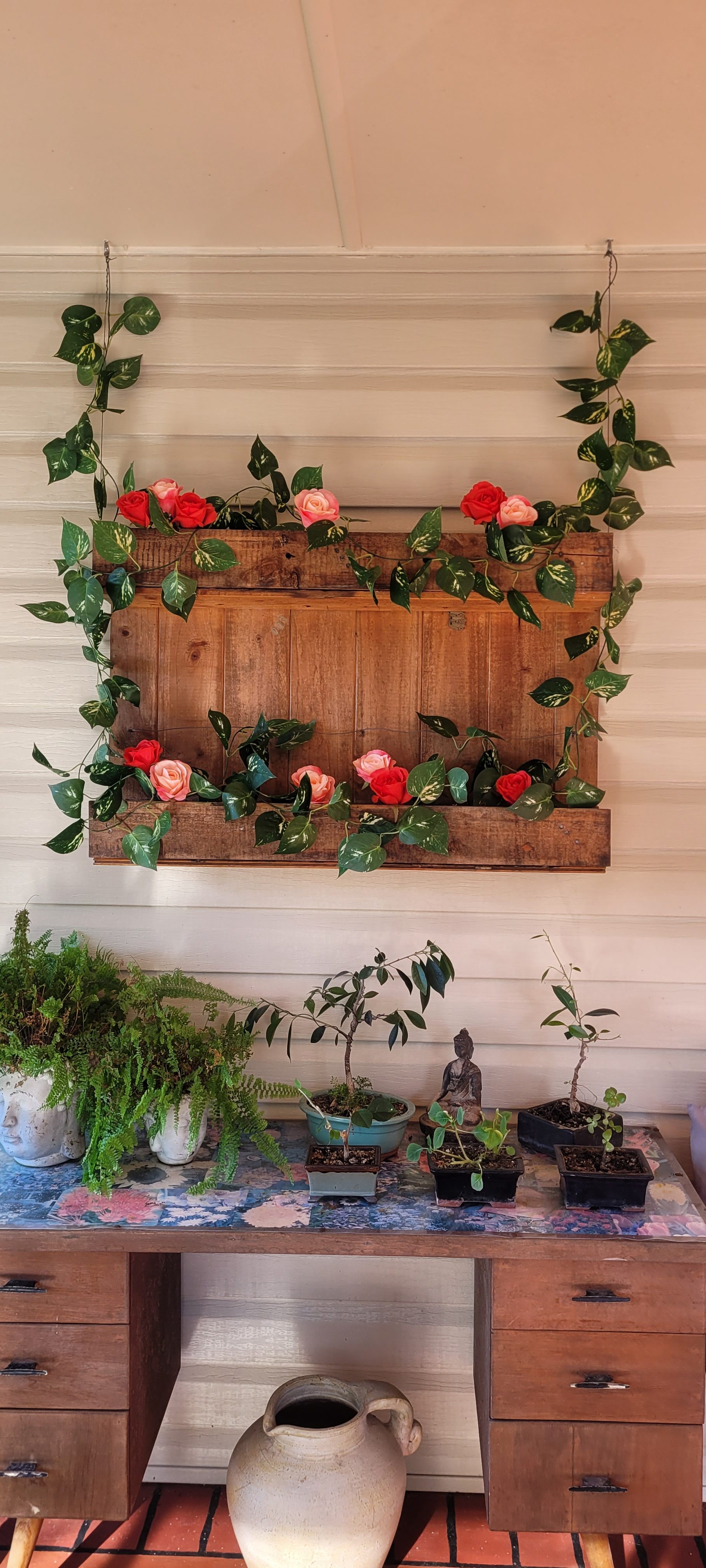
I have a confession to make. As avid a gardener as I am, artificial plants have recently found a home on my front verandah, and they look great.
Think back to the early days of Covid. Gardening projects became everyone’s go to passion to fill in our days. Like a defiant expression of hope, Covid wasn’t going to deny us our freedom to create at home. Among many projects, I made a wooden pallet garden, a minimal cost, rustic vertical space where I imagined plants would cascade down like a waterfall.. It has taken pride of place on the wall of my front verandah ever since. Its a reminder of the creativity that Covid brought out in us. But a challenge it has always been, like a goal that is never quite reached. Positioned in a spot that gets no direct sun, every plant I grew in the very small spaces never thrived. They either struggled and looked sick, or died. So it became a constant eye sore, looking unloved and sad. And each time I watered it, bits of potting mix or bugs would run down the wall.
What to do? What to do?
I love its location so didn’t want to move it. A trip to Kmart and the Reject Shop was in order. 2 metre lengths of fake Devil’s Ivy were perfect, snaking their way around the wires, and gently gliding across each level, like a lazy winding stream. A couple of bunches of fake flowers separated and snipped to size, and poked into the potting mix were then added.
My lifeless garden still looks pretty and reminds me of those dream sequences in movies where girls are swinging on a garden swing surrounded by flowers. Now I have a display that is frozen in time but with ongoing greenery and colour. No mess trailing down the walls and all for a cost of $21. And in time, I can replace the flowers with a new look.
Some might think that artificial flowers and plants arose in the 20th century but they have actually been around since 1000BC. The ancient Chinese created silk flowers and the Ancient Egyptians used painted linen, reeds, and stained horn, largely using their creations for religious rituals. In South America, feathers, wax and tinted shells were used. The Romans in 100BC also used wax to craft flowers and leaves. From the 12th to the 20th centuries, the Italians and French created silk flowers used by the nobility. But it wasn’t until the 19th century in the Victorian era where paper, satin and wax flowers were used in home decor.
The major breakthrough came in the 1950’s with the discovery of polyethylene, when mass production of artificial flowers began. Since then flowers have become more and more realistic, even to the point of being botanically correct, with the advent of polyester. Today the range of materials to create artificial flowers and foliage seems endless. On offer in many stores now is a rainbow of hues and textures, like a lush perennial garden with colours that never fade.


Leave a Reply