• Purple Dazzle

    The alarm startles me from my restless sleep. When I open my back door to greet the day, I am met by an old friend – the bright purple flowers of my Tibouchina shrubs. They bring joy to me every day of the year, without fail.

    I watch the vibrant flowers gently dancing and nodding in the breeze like fluttering butterflies. The long stamens, like spider legs, are bent and angular, with a contrasting colour to the flowers. Rightly so, the flower is also known as the eyelash flower. Pollinators are nuts about them.

    The leaves of the Tibouchina are distinctive. Long and hairy with veins that run the length of the leaf. Its actually the leaves that help me to identify a plant as a Tibouchina. A few weeks ago I saw a shrub that had a long conical shape of small white flowers. It didn’t look like a Tibouchina, but it was the leaves that gave it away.

    Native to Central and South America, Tibouchina are a shrub to small tree that grow well in the Northern Rivers. In fact, there is a Tibouchina developed in Alstonville, northern NSW. Tibouchina Lepidota ‘Alstonville’ is an evergreen shrub with long slender leaves and spectacular purple flowers.

    Tibouchina flowers range from vibrant purple through to mauve, pink and white. My absolute favourite is the purple, as brilliant as royal velvet saturating the trees.

    As a feature plant or as a hedge, Tibouchina is a winner in any garden.

  • Fake It If You Can’t Make It

    I have a confession to make. As avid a gardener as I am, artificial plants have recently found a home on my front verandah, and they look great.

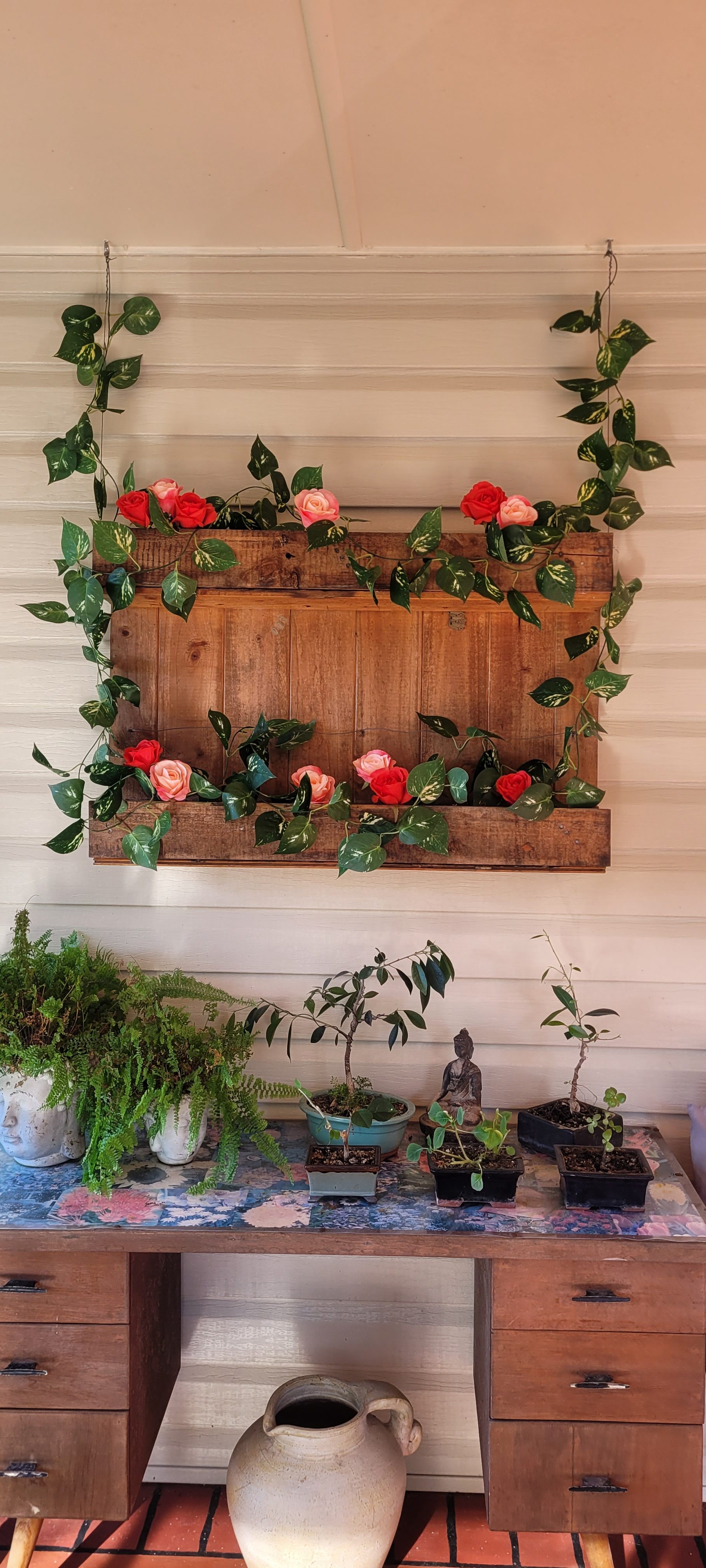
    Think back to the early days of Covid. Gardening projects became everyone’s go to passion to fill in our days. Like a defiant expression of hope, Covid wasn’t going to deny us our freedom to create at home. Among many projects, I made a wooden pallet garden, a minimal cost, rustic vertical space where I imagined plants would cascade down like a waterfall.. It has taken pride of place on the wall of my front verandah ever since. Its a reminder of the creativity that Covid brought out in us. But a challenge it has always been, like a goal that is never quite reached. Positioned in a spot that gets no direct sun, every plant I grew in the very small spaces never thrived. They either struggled and looked sick, or died. So it became a constant eye sore, looking unloved and sad. And each time I watered it, bits of potting mix or bugs would run down the wall.

    What to do? What to do?

    I love its location so didn’t want to move it. A trip to Kmart and the Reject Shop was in order. 2 metre lengths of fake Devil’s Ivy were perfect, snaking their way around the wires, and gently gliding across each level, like a lazy winding stream. A couple of bunches of fake flowers separated and snipped to size, and poked into the potting mix were then added.

    My lifeless garden still looks pretty and reminds me of those dream sequences in movies where girls are swinging on a garden swing surrounded by flowers. Now I have a display that is frozen in time but with ongoing greenery and colour. No mess trailing down the walls and all for a cost of $21. And in time, I can replace the flowers with a new look.

    Some might think that artificial flowers and plants arose in the 20th century but they have actually been around since 1000BC. The ancient Chinese created silk flowers and the Ancient Egyptians used painted linen, reeds, and stained horn, largely using their creations for religious rituals. In South America, feathers, wax and tinted shells were used. The Romans in 100BC also used wax to craft flowers and leaves. From the 12th to the 20th centuries, the Italians and French created silk flowers used by the nobility. But it wasn’t until the 19th century in the Victorian era where paper, satin and wax flowers were used in home decor.

    The major breakthrough came in the 1950’s with the discovery of polyethylene, when mass production of artificial flowers began. Since then flowers have become more and more realistic, even to the point of being botanically correct, with the advent of polyester. Today the range of materials to create artificial flowers and foliage seems endless. On offer in many stores now is a rainbow of hues and textures, like a lush perennial garden with colours that never fade.

  • Its Not Just About the Flowers

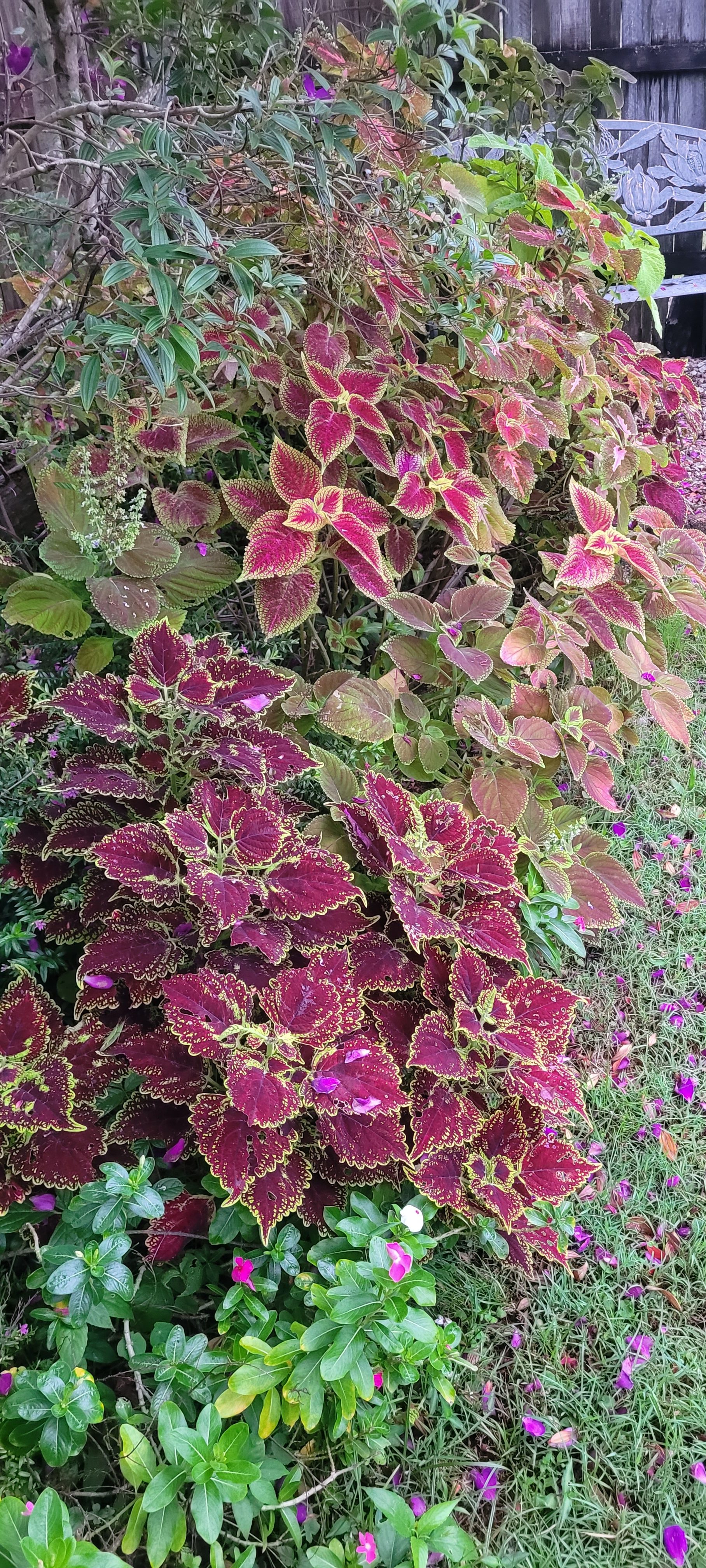
    Nestled and protected from the harsh afternoon sun, which can seem as hot as a furnace, my Coleus plants thrive in dappled shade. Native to Asia, they are well suited to the heat and humidity of the Northern Rivers, unlike this human who finds it a struggle. In a cooler climate, Coleus do well as an indoor plant.

    Known as nature’s velvet fabric, the leaves of the Coleus are like no other. As soft as a rabbit’s ear, they are amazing to touch, and provide a kaleidoscope of colour in any garden. With different sizes and shapes, the leaves seem to glow. An array of colours used as a garden border looks spectacular.

    As a member of the mint family, Coleus have the distinctive square stems and mint-like flowers.

    Speaking of the flowers, narrow flower stalks rise up from the plant desperately trying to compete with the stunning leaves below. But its no use. Very unexciting, they need to be pinched out with thumb and index finger to encourage growth of the star of the show.

    Staying foliage-focused is a winner for Coleus. Keeping the flower stalks leads to seed production which inhibits the leaves from flourishing. This ‘pinching out’ also promotes branching.

    Coleus are low maintenance, fast growing and adapt to a wide range of soils but need regular watering and good drainage. Wet feet are their enemy.

    Coleus are again becoming a feature in Australian gardens because they are easy to grow, easy to propagate from cuttings, but most of all, add a rainbow of stunning colours to any garden. The range of colours available seems endless, like a painter’s pallet.

  • Through the Arch Window

    Like a beautiful magnet the colour of hot pink lipstick, my Mandevilla climber beckons visitors to come closer. Large trumpet flowers that dance and sway in the breeze like ballerinas. Twisting branches that entwine and hug the arch support like braided hair. It really is the showpiece of my front garden at the moment.

    Long flowering from Spring to Autumn, this climber thrives in the Northern Rivers. Our heat and humidity suit it well as it is native to Central and South America. Commonly known as the Rock Trumpet, Mandevillas dazzle in any garden with their showy flowers of pink, red, white or yellow. They are also a favourite among butterflies and small pollinators.

    Arches, trellises and fences are all valuable supports for this delicately fragrant plant. By the way, arches have been used in gardens since ancient Egypt, more for practical and functional reasons such as supporting grape vines, or creating shaded walkways.

    It was in the Roman era that arches took on a decorative role, mainly for supporting roses. The concept of romantic or architectural garden rooms evolved from there. My rustic, old, metal arch works well at the beginning of a mosaic and gravel pathway, leading the visitor to parts of the garden so far unseen. Strolling through this leafy gateway, you may be brushed across the head or over the arm by a thin dangling branch that’s desperately trying to escape the constraints of the arch.

    But secateurs are banned. After flowering, the stray branches will be woven through the arch ready for next season’s bloom. And after all, the tactile sensation of brushing against foliage is one of the delights of immersing yourself in a garden.

  • The Shrub of Changing Colours

    A rainbow of colour hugging the walkway greeted me in the Hydrangea section of the Christchurch Botanic Gardens. On my recent trip to New Zealand, I made a point of wandering through the Gardens. Being Summer rather than Spring, some of the displays lacked flowers , but the Hydrangeas did not disappoint.

    Have you ever wondered why Hydrangeas can change flower colour based on soil type, but other flowers can’t?

    Its because while other flowers rely purely on genetics to determine flower colour, Hydrangea flowers contain a pigment that is capable of changing colour in the presence of aluminium ions. White Hydrangea don’t have this pigment so remain white.

    So let’s get the dirt on this colour changing business.

    Acidic soils (pH 6 or less) produce blue flowers because the plant is able to take up aluminium ions from the soil as they are soluble and mobile. Aluminium builds up in the flower turning it blue. Aluminium sulphate can be added to the soil to achieve this also. Coffee grounds mixed in the soil are another way to achieve blue flowers.

    In alkaline soil (pH 7 and above) aluminium ions are not available for uptake as they combine with other elements making them unavailable to the plant. As a result, pink and red flowers bloom. Lime can be added to the soil to encourage pink and red flowers.

    A neutral soil (between pH6 and pH 7) will produce purple or mauve flowers as only a small amount of aluminium is available.

    Now that’s enough science.

    The most diverse range of Hydrangeas are native to Asia, mainly China, Korea and Japan. As well as shrubs, there are small trees and climbers.

    Hydrangeas like morning sun, dappled light, and definitely protection from afternoon sun. Regular watering is important too.

    In my garden, I don’t try to manipulate my soil for specific colours at all. In the garden bed I get blue flowers and in my pots I get pink flowers. At the Christchurch Botanic Gardens, the staff must work diligently to manipulate the pH of the Hydrangea soil as there are different colours blooming alongside each other.

    Hydrangeas are a spectacular plant, with their large, showy flowers through Spring and Summer. They are one of my favourites.

  • Its All About the Colour

    In my Canberra garden along a pathway, I planted a row of Lavender with African Marigolds in front. The flowers bloomed like friends accompanying me every step of the way down the path. The combination of purple and yellow looked stunning and I have been hooked on it ever since. They are like sunshine and twilight in a single glance.

    Why do these colours work? They are complementary colours on the colour wheel, creating balance – calming purple with energetic yellow. They add a vibrant natural harmony to gardens.

    To my surprise, after I planted my double yellow Allamanda creeper on the front fence in my current garden, I discovered that I had a Petrea Volubilis growing nearby. (Flashback to Darwin – this is one of the few botanical names I remember from my Horticulture course). What a great day that was – discovering that purple and yellow are to be enjoyed together again.

    Petrea Volubilis, or Tropical Wisteria, has many common names including purple wreath, queen’s wreath, and sandpaper vine. Its a woody evergreen climber native to tropical America. Needing full sun, it flowers Spring and Summer. The purple star-shaped flowers are spectacular, hanging like clusters of grapes on a vine. The leaves are just as amazing with a texture of sandpaper, as rough as a cat’s tongue. Butterflies are attracted to its nectar-bearing blooms.

    Apparently, there is an incredible display of Petrea Volubilis at the Bundaberg Botanic Gardens.

    My Petrea grows near my driveway and the long branches often drape over the driveway after rain. They look beautiful but they won’t be cut back until after flowering, even though they kiss the roof of my car each time I drive through.

  • The Enemy Lurks

    A few weeks ago, I was admiring my red Pentas shrub, covered in an explosion of tiny star-shaped flowers. “I will take a photo of that tomorrow.” Therein was my mistake. Returning the next day with camera in hand, I was shocked. This can’t be the same plant. Overnight, two thirds of the shrub had been defoliated. Flowers and leaves gone, just stems remaining. It was as bare as a skeleton.

    On close inspection, the culprit was revealed. Camouflaged along the green stems lay numerous eating machines, otherwise known as caterpillars. And I swear they had a smile on their face, Time to get even. Weapons gathered – a bucket of water, gloves, and glasses, as I didn’t want to miss any. The operation took some time, but the enemy was removed and disposed of. Fortunately I checked all my Pentas and discovered voracious visitors on them all, an army of invaders destined for the bucket.

    The good news is that after a cut back of all the defoliated stems, my Pentas are now covered in new growth and flowers in just a few weeks. The lesson learnt – recognise the enemy, patrol its haunts, and act swiftly when detected.

    After reading this story, you may think that Pentas are more trouble than they are worth. But no. They are worth the effort. Pentas are an attractive compact perennial shrub, although may act as an annual in cold climates. Native to Africa, Pentas is commonly known as the Egyptian Star Flower. Masses of pink, white, red or lilac flowers cover the shrub almost all year round. No wonder they are popular with pollinators, having a consistent supply of nectar. Hawk moths, also known as Sphinx moths, lay their eggs in Pentas. That is what my hungry green enemy hatches from.

  • If At First You Don’t Succeed…….

    Stretching down the edge of my driveway, there was once a narrow strip of grass that was more trouble than it was worth. Jutting out like the jagged edge of a saw blade, the fence posts that hugged the edge of the grass made the mowing slow and laborious.

    The grass had to go.

    Covid had raised its ugly head. It was a personal assault on our lifestyle. Imprisoned in our homes, we turned to gardening. A vegetable garden for this narrow strip of ground would be the answer. A mini farm on my doorstep, providing a calm escape from the chaos of this new world. Removing the grass, turning over the soil, then zucchini, snow peas, corn, cucumber, capsicum, radish and tomatoes were planted.

    The sun beat down, and some of the veges grew well. But there were many failures. The vege garden looked like a battlefield where there were few survivors. Bugs ravaged the produce and I felt like I was at war with nature. The soil was very poor quality.

    What to do?

    Raised garden beds were the answer. But enter my cat, Sapphire. She would have a field day digging out the soil in every direction. Did I want to invest in covers as well? No. So ended the vegetable garden idea in that location.

    A new idea was born – somewhere to grow on and sun harden my propagated plants would be ideal. I levelled the ground and blanketed it with weed mat. Like a lid on a box, it sealed the weeds in darkness. Variety was going to be the key – black plastic pots large and small would be placed among black cypress mulch. The black pots blended in like a shadow in the dead of night, brilliantly disguised at no extra cost. Varied textures in foliage and a rainbow of colour was created by my pots en masse.

    Timber and stone edging completed the garden bed. My old vanity basin now takes pride of place on the corner of the area, like a guard protecting the entrance.

    My black pot garden is a success. Pots are rotated regularly, providing immense interest to the entrance of the property. And as an extra bonus, there is no digging or weeding. So now, during the day, Sapphire, as black as midnight, can hide amongst the shade of the pots. She delights in laying in wait and then springing out at me as I wander past.

  • The Plant That Gives and Gives

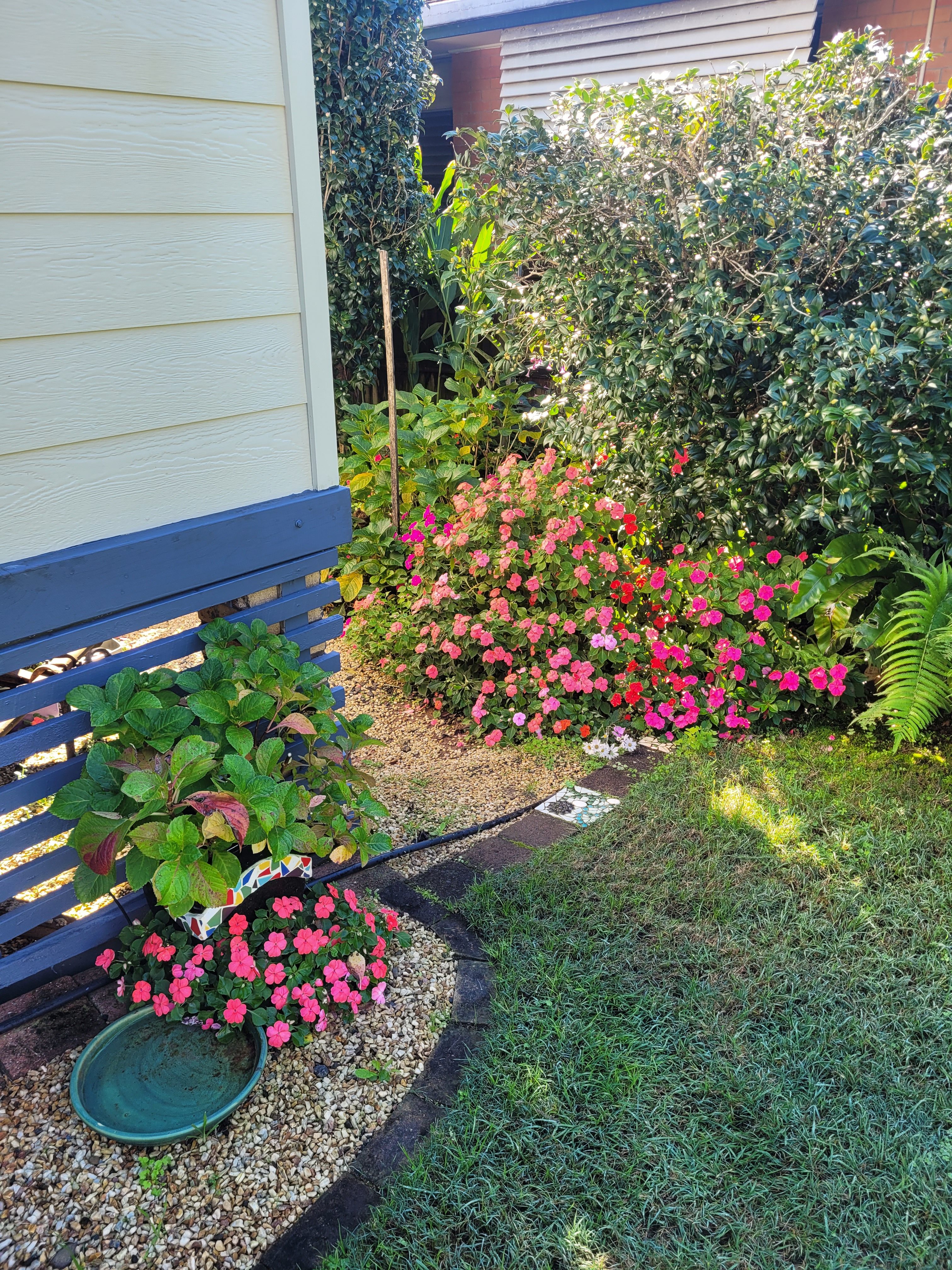
    A vibrant carpet of fragile pink flowers, ranging from pale fairy floss to rich raspberry, invites me to enter. It hugs the gravel pathway on the eastern side of my house.

    Strolling down the path, I find a new surprise each day. A seed pod that burst open has cast its seeds far and wide. Among the gravel, on the edge of the lawn, and in the cracks of the pavers, new plants are emerging, like secrets being revealed.

    So is the brilliance of Impatiens, also known as Busy Lizzie. From the Latin, Impatiens has another common name – ‘Touch-me-not’ – which refers to the sudden bursting of the ripe seed pods when touched. With succulent soft stems (herbaceous) this plant can be very fragile, like the threads of a spider web. At the same time though, as long as it doesn’t have wet feet or is inundated by harsh afternoon sun, Impatiens is easy to grow. As a bonus, there is no deadheading necessary. I planted a couple of punnets of seedlings a few years ago and they just keep on keeping on, flowering all year round. Most of my Impatiens enjoy morning sun, light watering and plenty of organic mulch. If they do get leggy and die back, a trim is all that’s needed to revive them. Impatiens can also grow in shade, but they will be taller with less flowers.

    Attracting pollinators like bees and butterflies, Impatiens is an asset to a garden. It is a very versatile plant, suitable for garden beds, hanging baskets, and pots. Pet safety is another bonus.

    Impatiens is an attractive plant, creating a beautiful understory in my garden.

  • Garden Friends

    I pull on my well-worn dusty boots and grab my water bottle. An ancient op shop straw hat that has seen better days is plonked on my head. I’m ready for a few hours in the garden. I know I won’t be alone while I’m digging with my heavy and weathered mattock, planting and watering my new purchases, and pruning other plants that are getting a bit leggy.

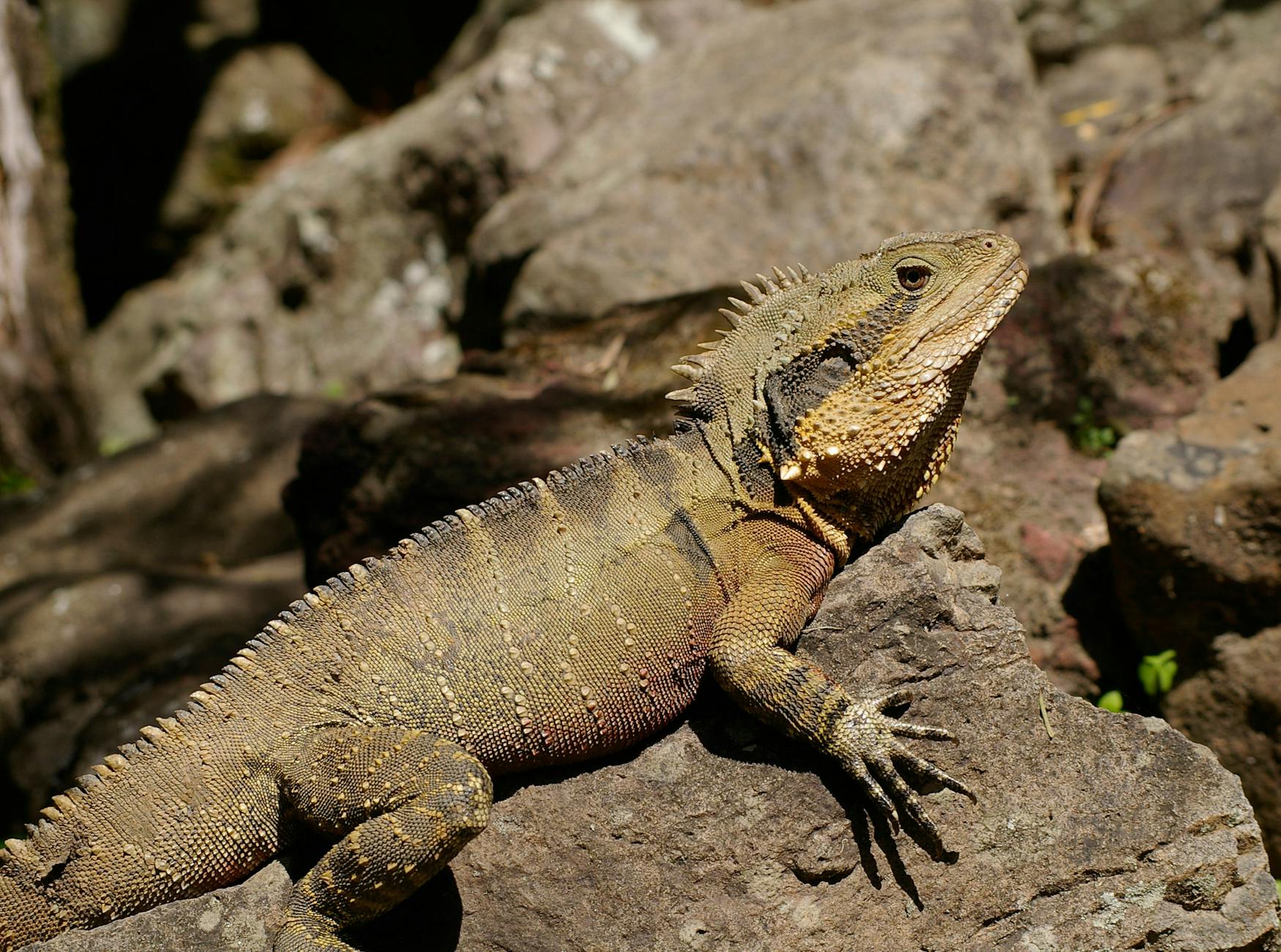
    There will be a rustling in the mulch, a scampering across the path, and a statue frozen on the lawn eyeing me off. My resident water dragons are about, checking me out, but not too close. There’s something prehistoric about them with their long thin tails and spines down their back. Friend or foe, the mum on the lawn wonders. Frozen until she’s sure, she relaxes when I say “Hello Lizzy”. (I have to get more creative with the names – so far they are all called Lizzy).

    I like to think of them as a family – mum, dad and the children, but I really have no idea of their connection. I do know they are very happy to call my garden home. Sunning themselves on the gravel rocks, submerging in the cool water in my mosaiced bird baths, climbing up branches in search of food, or just keeping an eye on me. My water dragons are a joy to have around. As time goes on, they are getting more curious about me, not quite as panicked when I walk by.

    Fun facts – did you know?

    This protected lizard is the only Australian lizard that grabs its food with its short, thick tongue (the others use their jaws)

    In my garden they eat frogs, insects and vegetation

    They are great swimmers and can stay submerged for 30 minutes

    They dig a slanted vertical hole for a nest

    All in all, a great asset in any garden, but too speedy to photograph when I tried to get close. So for the first time, the photo accompanying this blog is not my own.